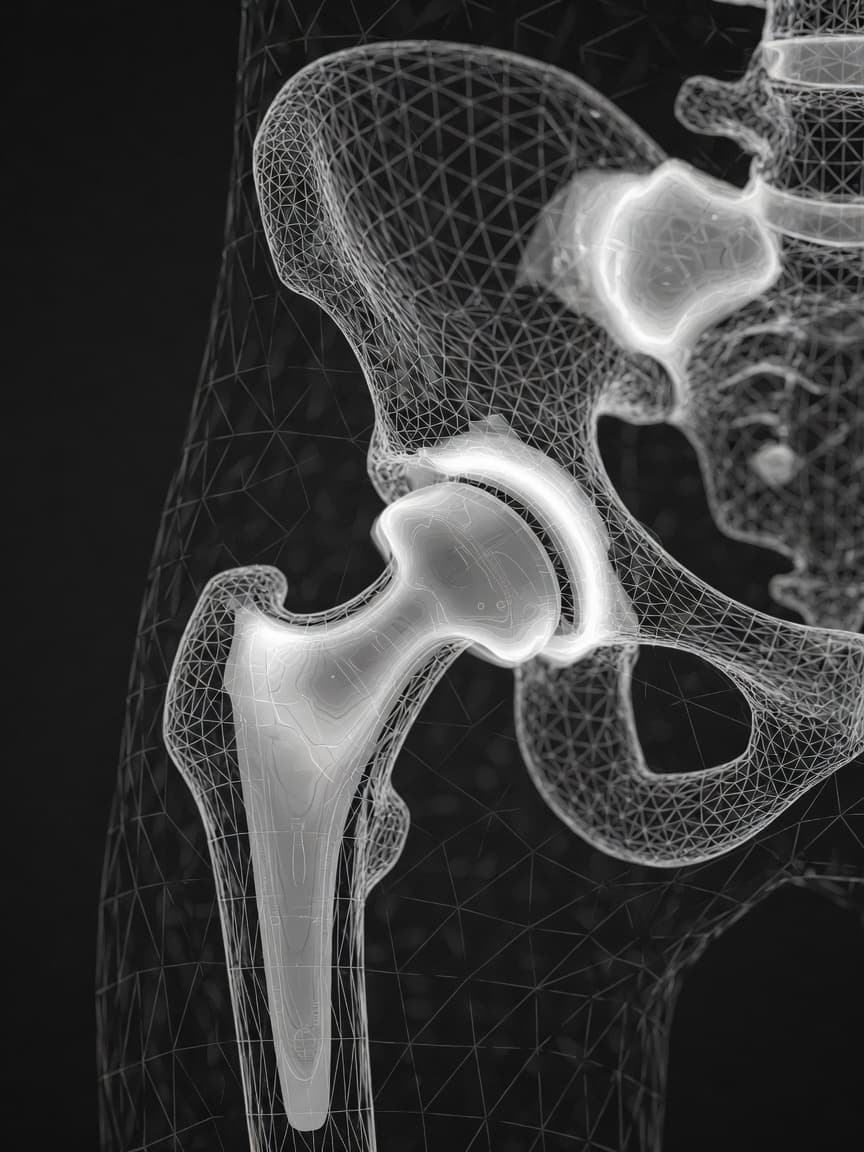
Applied mathematics and computer science for orthopedic technology. Patient-specific simulation, statistical validation, and traceable translation from equation to operating room.
Applied mathematics and computer science converging with orthopedic science. Formal models, algorithms, and statistical inference driving the next generation of musculoskeletal technology.
Digital Twin Biomechanics
High-fidelity computational replicas of patient-specific joint environments. We build 2.4M-element finite element models with calibrated constitutive laws and fuse IMU and fluoroscopy streams at 1.2ms latency.
Bayesian calibration maintains 99.4% state synchronization across edge and cloud, flagging implant stress hotspots before they manifest clinically so surgeons act on formally validated predictions.
Twin state updates propagate from preoperative planning through intraoperative navigation and post-operative rehabilitation, keeping computational forecasts aligned with measured joint kinematics at every stage of care.
Scope
Patient-specific
Update rate
Real-time
Protocol
Validated
Applied Mathematics
Continuum mechanics, inverse kinematics, and Bayesian calibration. Patient-specific models predict implant stress, joint kinematics, and failure probability with quantified uncertainty.
Finite element assemblies encode bearing contact and cement mantle mechanics, while Markov chain Monte Carlo sweeps constitutive parameters to produce credible intervals on peak stress.
Sensitivity analysis ranks which anatomical inputs most shift the outcome, directing acquisition effort where it reduces uncertainty fastest before surgery begins.
Method
Finite element
Control
Optimal
Output
Uncertainty bounds
Computer Science
Real-time sensor fusion, differentiable rendering for surgical navigation, and distributed ML inference across edge and cloud systems.
Differentiable renderers back-propagate registration error into pose corrections at 240 Hz, keeping tool trajectories locked to the underlying biomechanical model through the full procedure.
Exported ONNX models run on sterile-field edge nodes when cloud round-trip would exceed the operating team reaction window, with version-controlled rollbacks for every deployment.
Fusion
Edge + cloud
Latency
1.2 ms
Render
Differentiable
Bio-Materials
Next-generation osseointegration substrates engineered at the cellular level. Implants that bond with bone as living tissue rather than passive fixation.
Porous tantalum and magnesium-zinc scaffolds are sintered with pore architectures matched to osteon invasion kinetics from twelve-week histology cohorts.
Surface chemistry and trabecular strut spacing are tuned so bone integrates as living tissue, reducing fibrous encapsulation and improving long-term implant stability under physiological load.
Bond
Osseointegration
Fusion
99.4%
Class
VI Med
Next-Gen Orthopedics.
We advance orthopedic technology by applying rigorous mathematics and computational science to musculoskeletal problems. From finite element stress analysis to machine-learned surgical planning, every solution is formally modeled, statistically validated, and clinically translated.
F1 Help│F2 Save│F9 Assemble│F10 MenuOpen│Ln 25, Col 1│Ins│
Computational Foundations
Rigorous applied mathematics and computer science. Formal models, algorithms, and statistical inference translated into clinically validated orthopedic systems.
Computer Science
Algorithms & Real-Time Systems
Sub-millisecond fusion unifies IMU, fluoroscopy, and robotic encoder streams into a single joint state estimate at the workstation. Differentiable rendering reconstructs patient anatomy in real time so tool trajectories stay locked to the underlying biomechanical model through the full procedure.
Latency budgets are enforced end to end: edge nodes preprocess raw streams, the workstation runs pose graph optimization, and cloud replicas replay cases for regression testing before any algorithm revision reaches the sterile field.
Statistical Inference
Bayesian Clinical Modeling
Hierarchical Bayesian models pool multi-center cohorts to forecast revision risk, pain trajectories, and range-of-motion recovery under explicit priors. Causal graphs separate confounding from treatment effect when implant designs are compared across national registries.
Posterior predictive checks and pre-registered analysis plans travel with every submission, so interim reads and final endpoints remain statistically defensible under regulator scrutiny.
Digital Twins
Multi-Physics Simulation
Coupled fluid-structure interaction and musculoskeletal multibody models advance in lockstep with wearable IMU streams at 200 Hz. Tissue remodeling equations update bone density maps as cumulative load histories accrue through rehabilitation and return-to-sport protocols.
Physics-informed neural networks compress high-fidelity finite element runs into bedside inference without relaxing the conservation laws that govern joint mechanics, keeping twin state synchronized with the operating room and the clinic floor.
Experimental Validation
Model Verification & Calibration
Cadaveric joint testing, mechanical indentation, and dynamic fluoroscopy supply ground-truth loads and kinematics against which finite element predictions are scored. Discrepancies above five percent trigger mesh refinement or constitutive law revision before any model enters the surgical workflow.
Calibration reports attach measured versus predicted strain fields, contact pressure maps, and migration traces so clinical teams can audit model fidelity at the case level.
Applied Mathematics
Continuum Mechanics & Optimization
Patient-specific finite element models map implant geometry, bone density, and joint loading into calibrated stress fields across meshes exceeding two million elements. We solve constrained variational problems to locate von Mises hotspots, contact pressures, and subsidence risk before any bone is cut.
Inverse kinematics and convex optimal control tie preoperative plans to intraoperative navigation. Constitutive parameters carry explicit uncertainty bounds from sensitivity analysis, so every implant position is justified by formally stated mechanics rather than surgeon intuition alone.
Equation to clinic
Acquisition
CT and MRI volumes pass through semi-automated segmentation to recover cortical shell thickness, trabecular density, and implant clearance envelopes. Motion capture, dual-plane fluoroscopy, and surface EMG record gait and stair-climb kinematics under IRB-approved protocols at six partner hospitals.
Modeling
Hex-dominant meshes inherit patient geometry while constitutive laws for bone, cartilage, and polyethylene are fit from indentation and explant data. Parameter identification runs on version-controlled pipelines so every material constant traces to a primary measurement.
Inference
Bayesian calibration propagates measurement noise through contact mechanics and produces posterior intervals on peak stress, migration, and wear rate. Sensitivity analysis ranks which anatomical inputs most shift the outcome, directing acquisition effort where it reduces uncertainty fastest.
Translation
Pre-specified endpoints from the computational model enter Phase II trials with continuous monitoring against twin predictions. Regulatory submissions bundle statistical analysis plans, mesh provenance, and software hazard logs so clinical deployment remains auditable end to end.
Research Spotlight
Selected publications demonstrating our commitment to mathematically rigorous, reproducible orthopedic science: formally modeled, statistically validated, and traceable to primary literature.
A hierarchical Bayesian framework for calibrating patient-specific FEA models of THA with quantified uncertainty bounds on implant stress and subsidence risk.
Vance E., Chen J. · Computer Methods in Biomechanics and Biomedical Engineering